
Overgrown Canopies Create Structural Problems
Tree Trimming and Pruning in Jackson for crowded canopies, crossing limbs, and trees outgrowing their space on residential properties
Canopy pruning and structural trimming involve more than cutting back visible growth—the cuts made determine how the tree develops its branch architecture over the following years. A1 Outdoor Services performs tree trimming and pruning in Jackson for property owners dealing with limbs encroaching on rooflines, crossing branches that create friction wounds, and canopies dense enough to block light to the structures and plantings below. Getting those cuts right matters as much as getting them made.
Pruning work begins with identifying which limbs are structurally sound and which are competing in ways that will eventually cause one to fail. On properties with mature trees—common across Jackson's established residential areas where large shade trees were planted when lots were first developed—branch spacing and load distribution have often never been addressed, meaning the canopy has self-organized around whatever growth was fastest rather than what was strongest. Each cut is placed just outside the branch collar so the tree's natural wound response is preserved and decay doesn't track back into the trunk.
Request a canopy evaluation from A1 Outdoor Services to identify which limbs are candidates for removal and what the pruning sequence should be for your specific trees.
How Pruning Addresses Long-Term Canopy Health
Effective pruning is selective by design: removing the right material while leaving the structure that supports long-term growth. That means identifying co-dominant stems that compete at the top of the tree, removing water sprouts that drain energy without contributing structure, and thinning interior growth that restricts airflow through the canopy. Each of those is a different problem requiring a different cut type, and conflating them produces results that look trimmed but don't resolve the underlying structural issue.
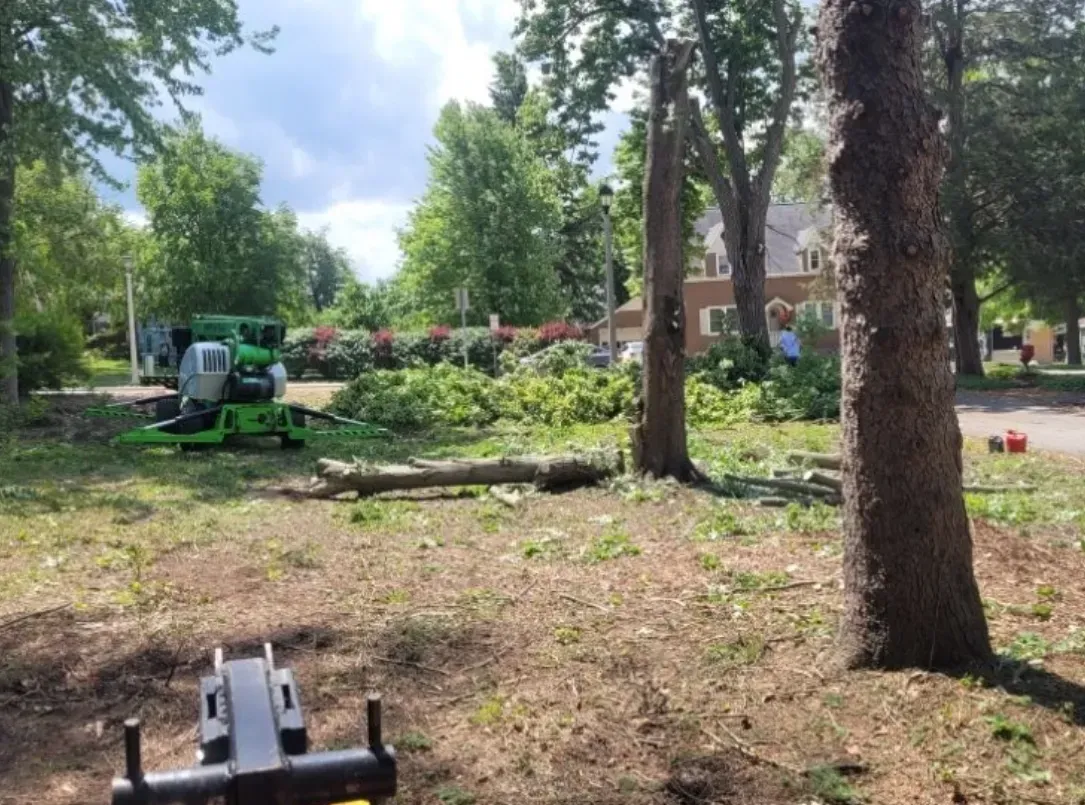
After pruning is complete, the canopy is noticeably more open and the branch lines are clearly defined—you can see the structure of the tree rather than just an undifferentiated mass of foliage. Limbs that were dragging over the roof or rubbing against gutters are removed, and the remaining branches have space to develop without creating new friction points. A1 Outdoor Services removes all cut material from the site so the lawn and beds beneath the tree are clear when the work is finished.
The timing of pruning relative to the tree's growth cycle affects how the tree responds, but the structural work of removing crossing, dead, or crowded limbs can be addressed at any point when the condition warrants it. Cosmetic shearing—cutting the outer edge of the canopy to a uniform shape—is not the same as structural pruning and doesn't resolve the interior branch conflicts that cause long-term problems.
What Property Owners Ask About the Work
Pruning decisions are often less obvious to property owners than they are to a trained eye. These questions address what makes the difference between pruning that improves a tree and cuts that set it back.
What is a branch collar and why does cut placement matter?
The branch collar is the swollen tissue at the base of a branch where it meets the trunk; cutting just outside it allows the tree to seal the wound, while cutting flush into the trunk removes that tissue and opens a pathway for decay.
How do co-dominant stems affect a tree's long-term structure?
When two stems of equal diameter compete at the top of the tree, neither develops the strength of a single dominant leader, and the connection between them is often a structurally weak V-crotch that becomes a failure point as the tree grows larger.
Why does canopy density matter for the buildings and plantings below?
A dense, unthinned canopy intercepts light and restricts airflow at ground level, which affects what can grow beneath the tree and concentrates moisture against any structures the canopy covers.
What distinguishes structural pruning from standard trimming on older Jackson residential trees?
Structural pruning works on branch architecture—removing competing leads, weak attachments, and crossing limbs—while standard trimming typically addresses only the outer edge of the canopy without resolving what's happening inside it.
How do you know when a limb is a candidate for removal versus one worth keeping?
Limbs with included bark at the attachment point, those crossing and rubbing against stronger branches, and those growing back toward the interior of the canopy are typically removed; limbs with strong, round collar attachments and clear growth direction are retained.
A1 Outdoor Services approaches pruning as a structural discipline rather than a cosmetic one, which is the distinction that produces results that hold up over time. Arrange a consultation to walk through your trees and identify the specific cuts that will make the most meaningful difference.